A 4-phase framework
for a successful AI business model
A holistic appraoch is critical!
vNo Business Anchoring
AI experiments without clear business objectives, ownership, or strategic relevance go nowhere.
vPoor Data Quality
Data silos, inconsistent formats, and unstructured data prevent scalable AI deployment.
vOrganizational Friction
Unclear responsibilities, resistance to change, and weak change management block progress.
vOverestimated GenAI Capabilities
Unstable outputs and limited reliability in production environments fail to meet expectations
Why 95% of AI projects fail
Why the 5% are successfull
vBusiness Case First
Clear business cases, measurable targets, and alignment with corporate strategy come first.
vData & Platform Readiness
A defined data strategy, consistent architecture, and scalable AI platforms are in place.
vBusiness + IT Joint Ownership
Close collaboration between domain experts and IT, with iterative and agile development.
vUsers Involved from Day One
Early end-user involvement, strong usability focus, and continuous feedback ensure adoption.
Sources: MIT 2025 Generative AI Pilot Projects Study, RAND Corporation 2024, McKinsey AI Success Patterns 2024
… as AI projects are NOT traditional IT projects
It is...
70% Psychology
20% Governance
10% Technology
> Change, Fears, Acceptance
> Processes, Responsibilities, Compliance
> Tools, Infrastructure, Data
4-Phase Framework for AI Implementation (detailed)
1. Analysis & Baseline
2. Strategy & Vision
Where are you?
- Current State Analysis
(Strategy, Business Model) - AI Readiness Assessment
- Innovation Framework
- SWOT Analysis
Where do you want to go?
- Target State Definition (Strategy, Business Model)
- Define AI Vision & Guiding Principles
3. Use Case Selection
4. Pilot & Implement
How do we get there?
- Use Case Ideation & Validation
- Business Case Development
- Cost-Benefit & Feasibility Analysis
How do we anchor & grow?
- Roadmap and Pilot
- Value Tracking & KPI Framework
- Scaling and Anchoring in Entire Organization
Across all phases:
Change Management & Stakeholder Alignment & Governance
Why now?
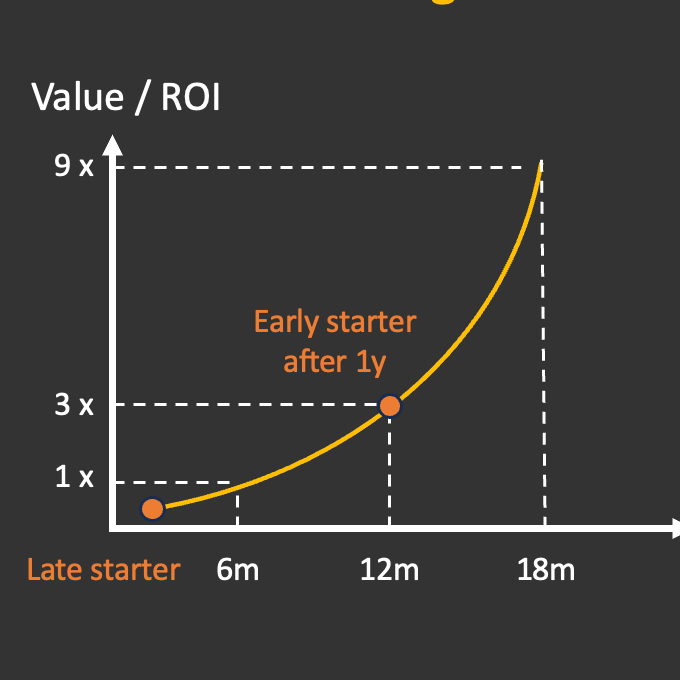
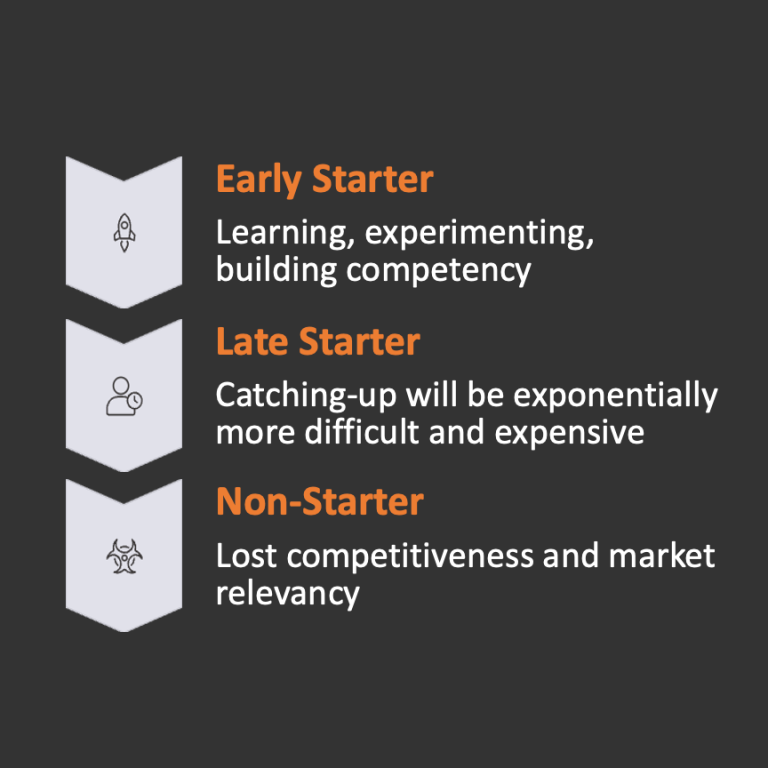
Those starting early will benefit exponentially over time. Late starters often can't catch-up.
The cost of waiting
Where are you?
“It’s not the big that eats the small — it’s the fast that eats the slow.”
Jason Jennings (Jennings & Haughton, 2002